International & Diplomatic Affairs
Grade
Three-year Bachelor’s
Major
Applied Languages and Global Careers(Minor in International & Diplomatic Affairs)
Campuses
Florence, Mantua, Turin
Admission
Admission upon selection
Mandatory Entry Test
Course Overview
Diplomacy is often called the quiet art behind global politics, the force that builds bridges, defuses crises, and shapes relations between nations. In a world defined by geopolitical tensions, technological disruption, and rapidly shifting power dynamics, the ability to negotiate, mediate, and understand global systems has never been more essential.
At Unicollege, this programme immerses you in the structures, institutions, and strategic interactions that define today’s international landscape. Courses such as International & Diplomatic Law, International Relations & Global Governance, and History of International and Diplomatic Relations provide a solid foundation for understanding how states collaborate, compete, and resolve conflicts in the international arena.
You will develop advanced analytical skills through modules like Applied Geopolitical Analysis, Security, Intelligence, and Terrorism, and Organized Crime and Transnational Mafias, learning to interpret geopolitical events, assess global threats, and understand the forces that shape international stability. The programme’s focus on contemporary challenges extends to courses such as Artificial Intelligence and Cybercrime and Crisis Management and International Relations, which explore how digital technologies, cyberattacks, and crisis scenarios are transforming modern diplomacy and international security.
Human dimensions of global relations are addressed through Human Rights & Peace Studies and Sociology of Evil and Radicalization, offering insight into conflict resolution, peacebuilding, and the socio-cultural processes that fuel radicalisation and violence. Meanwhile, Restorative Justice introduces alternative approaches to conflict mediation and post-conflict reconciliation, skills increasingly valued in international missions and humanitarian contexts.
Economic and structural perspectives are deepened through Economics of Global Markets, enabling you to understand how financial systems, trade networks, and global markets influence diplomatic strategies and geopolitical outcomes.
Throughout the programme, you will develop strong negotiation abilities, intercultural communication skills, and a strategic mindset, competencies essential for working in international organizations, diplomatic missions, NGOs, security agencies, and global governance institutions.
Graduates emerge prepared to contribute to diplomacy, conflict mediation, global policy analysis, and international security, equipped with the critical insight and global awareness needed to operate in complex, multicultural environments.
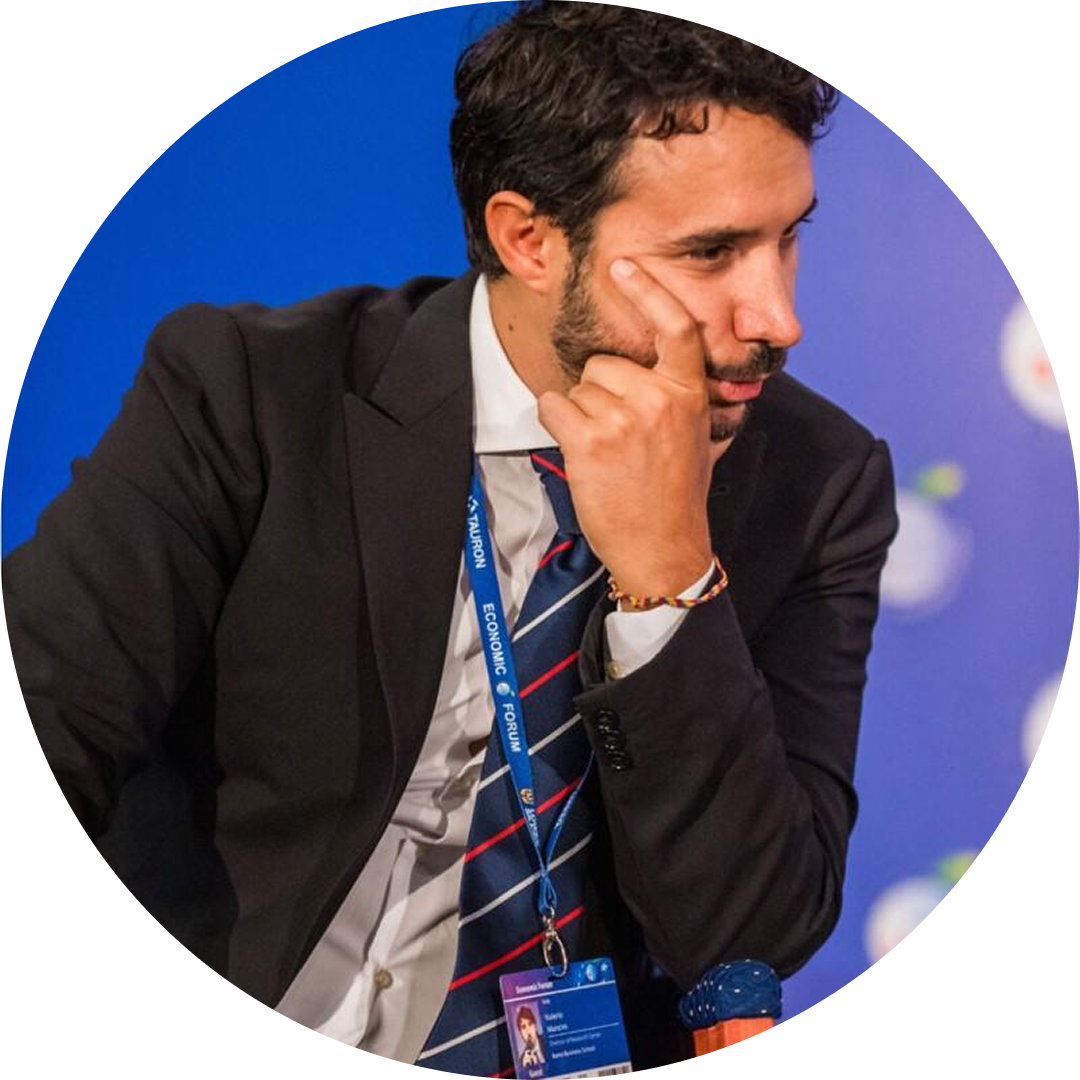
EdD c., Westcliff University, MA Economic Security, Geopolitics & Intelligence, MA International Affairs & European Integration
“Geopolitics teaches us to see how power moves across borders and shapes global realities. In my courses, students develop the analytical and strategic tools needed to understand international dynamics, anticipate change, and interpret the forces driving today’s complex world.”
Curriculum
| Courses | Credits |
| International & Diplomatic Law | 6 ECTS |
| International Relations & Global Governance | 6 ECTS |
| Applied Geopolitical Analysis | 6 ECTS |
| History of International and Diplomatic Relations | 6 ECTS |
| Diplomatic Theory and Practice | 6 ECTS |
| Foreign Language Component I (pre-intermediate/intermediate) | 15 ECTS |
| Foreign Language Component II (pre-intermediate/intermediate) | 15 (ECTS |
| Courses | Credits |
| Artificial Intelligence and Cybercrime | 6 ECTS |
| Crisis Management and International Relations | 3 ECTS |
| Human Rights & Peace Studies | 3 ECTS |
| Sociology of Evil and Radicalization | 3 ECTS |
| Economics of Global Markets | 6 ECTS |
| Foreign Language Component I (intermediate/advanced) | 15 ECTS |
| Foreign Language Component II (pre-intermediate/advanced) | 15 ECTS |
| Comparative Literatures and Contemporary Literatures | 6 ECTS |
| Language, Communication and Artificial Intelligence | 6 ECTS |
| Corsi | Crediti |
| Security, Intelligence, and Terrorism | 6 ECTS |
| Restorative Justice | 3 ECTS |
| Organized Crime and Transnational Mafias | 3 ECTS |
| Foreign Language I (advanced/proficient) | 15 ECTS |
| Foreign Language II (upper-intermediate/proficient | 15 ECTS |
| IT | 3 ECTS |
| Internship | 6 ECTS |
| Thesis | 6 ECTS |
| TOTAL CREDITS | 180 ECTS |
In the Unicollege learning system, your study plan includes one or more foreign languages taught through an immersive and applied methodology, where language becomes not just a subject to learn but the tool through which you think, communicate and build knowledge. From the very first year, courses engage you in active, hands-on workshops that blend theory and practice, ensuring that you are never a passive observer but the true protagonist of your learning experience.
The classroom transforms into a real-world environment: a working table, a negotiation setting, a professional simulation. You learn by doing, using the language to solve problems, make decisions, persuade, collaborate and bridge linguistic and cultural divides.
Language development follows a progressive and structured pathway. Starting from the proficiency level achieved in high school, you are guided step by step toward full operational fluency. Active learning, applied practice and workshop-based strategies replace traditional lectures, promoting a method centered on action, interaction and practical language use in authentic contexts.
Upon completing the Bachelor’s, you will be qualified to work in:
- International organizations such as the United Nations (UN), European Union (EU), European Union Intellectual Property Office (EUIPO), Organization for Security and Co-operation in Europe (OSCE), North Atlantic Treaty Organization (NATO), European Central Bank (ECB), and World Trade Organization (WTO).
- Think tanks and consultancy organizations such as BRUGEL, EGMONT Institute, DCAF, and consultancy firms like KANTAR Public.
- Non-governmental organizations (NGOs), including humanitarian, cultural, and scientific associations, as well as governmental organizations dedicated to mediation, particularly in communication and conflict resolution programs.
- Political, diplomatic, and cultural mediation entities.
- Humanitarian missions and organizations.
- Peacekeeping sector.
- International security.
- Non-profit and cultural associations.
- Strategic consulting for international organizations.
- Public administration.
- International training programs.
Find out about our Tuition & Fees
Any doubts?